Customized for Your Store, Designed for Global Markets
Contact Email: info@lotusfixtures.com
Why 100% Self-Produced Fixtures Beat Outsourced Shop Displays In Quality & Cost
Choosing between self-produced and outsourced store fixtures greatly impacts your retail store quality, budget, and project timeline. Learn why 100% in-house manufactured display cabinets deliver better quality consistency, lower hidden costs, stable lead times, and reliable after-sales support for global retail and chain store brands.
By Lotus Store Fixtures
Custom store fixtures and display cabinets factory with 20+ years of manufacturing experience.
Introduction
When planning a new retail store, chain outlet, or brand flagship, many buyers focus only on the final look of the display cabinets. However, the real difference between a successful store project and a problematic one often lies in how the fixtures are produced.
For overseas buyers importing store displays, choosing a supplier who relies on multiple outsourced workshops can create hidden risks. These risks include inconsistent quality, unclear costs, delayed delivery, poor communication, and difficulties with after-sales support.
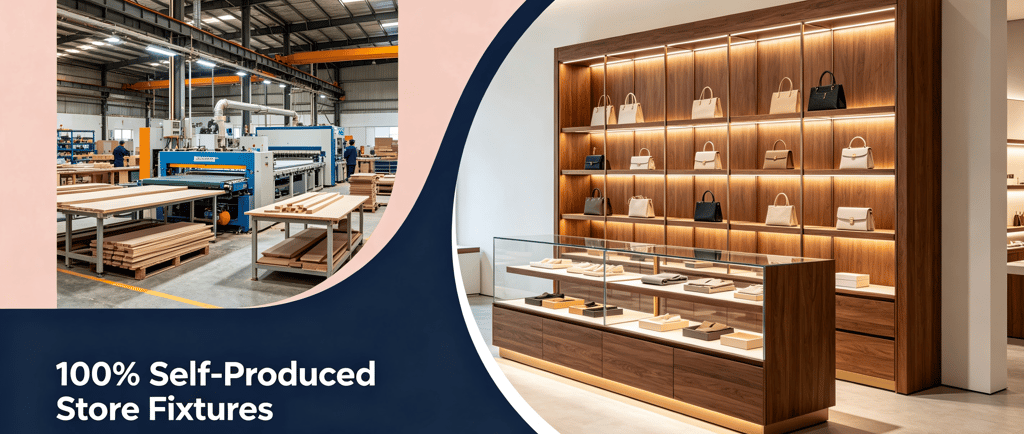
That is why 100% self-produced store fixtures have become a stronger choice for serious retail brands. When a factory controls every production stage in-house—from woodworking, hardware, painting, and spraying to final assembly—the entire project becomes more predictable, stable, and cost-effective.
What Does “100% Self-Produced Store Fixtures” Mean?
At Lotus Store Fixtures, “self-produced” means we do not simply design and resell display cabinets. We control the complete manufacturing process within our own factory.
This includes:
Woodworking workshop
Hardware workshop
Paint workshop
Automated spraying line
Assembly area
Quality inspection station
Export packaging department
Every stage is managed by our own team, from raw material selection to finished product testing.
For customers, this means one point of contact, one quality standard, and one clear production timeline.
Quality Control: The Biggest Advantage of In-House Production
One of the most important benefits of self-produced store fixtures is tighter quality control.
When production is outsourced, different parts of a display cabinet may be made by different workshops. One supplier may handle woodwork, another may do metal parts, and a third may handle painting. This can cause variations in color, finish, structure, and overall fitting accuracy.
With in-house production, every component is made under the same factory standards.
Key quality advantages include:
Consistent material selection
Precise cutting and assembly
Uniform paint and spraying finish
Stable hardware installation
Strict finished product inspection
Fewer errors during on-site installation
For chain store projects, this is especially critical. If one store’s display color differs from another, the brand image becomes inconsistent, and customer experience weakens.
Cost Control: Self-Production Reduces Hidden Expenses
Many buyers assume that outsourced production is cheaper. In reality, outsourcing often creates hidden costs.
Each external workshop adds its own margin. Coordination errors, rework, delays, and quality problems can also increase the final project cost.
With 100% in-house production, these extra layers are removed.
How self-production improves cost control:
No intermediate supplier markup
Clearer pricing structure
Better control over material waste
Fewer rework costs
More accurate production scheduling
Lower risk of unexpected delays
This does not always mean the lowest price, but it often means a more stable, transparent, and reliable total cost for the project.
For retail brands planning long-term store expansion, this is extremely valuable.
Faster Lead Time and Better Project Coordination
Store fixture projects are often time-sensitive. A delayed display cabinet production can delay the entire store opening schedule.
Outsourced production involves multiple teams and longer communication chains. If one workshop is late, the entire project can be affected.
In a self-produced factory, the project manager can coordinate all departments directly.
This leads to:
Faster decision-making
Shorter feedback loops
More accurate production scheduling
Easier design adjustments
Better control over delivery dates
Smoother export preparation
For international buyers, this is particularly important. Once production is delayed, shipping, customs clearance, and store opening plans can all be affected.
Better Communication for Custom Retail Projects
Custom store fixtures are not standard products. They require decisions about size, color, material, lighting, logo placement, load capacity, and store layout.
When production is outsourced, the buyer may communicate with a salesperson, who then communicates with several external workshops. This increases the risk of misunderstanding.
With in-house production, the factory team can understand the design intention more clearly.
This improves communication in areas such as:
Custom design requirements
Material selection
Brand color matching
Structural safety
Display functionality
Installation method
Export packaging
The result is a display cabinet that matches the brand’s vision more closely.
Why Chain Store Brands Prefer Self-Produced Fixtures
For chain store brands, consistency is everything.
Customers should have the same brand experience in every store, whether in Europe, the United States, Australia, or New Zealand. If display units vary in color, structure, or quality, the brand loses reliability.
Self-produced factories are better able to create standardized store fixture systems.
Chain store benefits include:
Uniform display style across all locations
Consistent material and finish standards
Repeatable production processes
Easier batch ordering
Clearer quality auditing
More reliable store rollout support
This is why many growing retail brands eventually move from small local suppliers or outsourced workshops to factories with full in-house production capabilities.
Common Risks of Outsourced Shop Displays
Outsourcing is not always bad, but it carries certain risks that overseas buyers should consider.
These include:
Inconsistent quality
Different workshops may follow different standards.
Color mismatch
Paint or wood finish may vary from batch to batch.
Structural instability
Hardware and woodwork may not be properly matched.
Poor communication
Design changes may not reach the actual production team.
Delayed delivery
Multiple suppliers can cause scheduling conflicts.
Difficult after-sales support
Responsibility for problems may be unclear.
Higher hidden costs
Rework, delays, and repairs can increase the final budget.
For a retail brand investing in store image, these risks can be costly.
How We Ensure 100% In-House Production at Lotus Store Fixtures
At Lotus Store Fixtures, we have built a complete production system for custom store fixtures and display cabinets.
Our production includes:
1. Woodworking Workshop
We handle all wooden structure production, including cutting, carving, shaping, and cabinet assembly. This ensures precise dimensions and stable construction.
2. Hardware Workshop
Metal brackets, display frames, connectors, and structural parts are produced in-house. This improves strength, compatibility, and long-term durability.
3. Paint Workshop
Our paint workshop ensures smooth, even, and brand-matched finishes. This is essential for high-end retail display cabinets.
4. Automatic Spraying Line
The spraying line provides consistent surface treatment, reducing manual errors and improving production efficiency.
5. Quality Inspection
Every finished display cabinet is inspected before packaging. This includes structure, finish, hardware, lighting, and overall appearance.
6. Export Packaging
We use packaging methods suitable for international shipping, helping to reduce damage during long-distance transport.
Which Type of Buyer Benefits Most from Self-Produced Fixtures?
Chain retail brands
Who need consistent store fixtures across multiple locations.
Single store owners
Who want a fully customized store layout with reliable quality.
Importers and distributors
Who need stable production and clear pricing.
Sports, footwear, and apparel brands
Who require durable, branded display systems.
Boutique and premium retailers
Who care about finish accuracy and brand image.
If you are serious about store quality and long-term brand consistency, 100% self-produced fixtures are usually the better choice.
Conclusion
Custom store fixtures are more than just furniture. They are part of your brand’s customer experience, product presentation, and store image.
Outsourced shop displays may seem convenient at first, but they often come with hidden quality risks, coordination problems, and unexpected costs.
100% self-produced store fixtures offer better control over quality, cost, lead time, and communication. For international buyers, this means a more reliable manufacturing partner and a smoother project experience.
At Lotus Store Fixtures, we believe that a good display cabinet should not only look good in photos—it should also be well-built, consistent, durable, and ready for global retail environments.
Ready to Discuss Your Custom Store Fixture Project?
If you are planning a new store, chain expansion, or display cabinet upgrade, we can help.
We offer:
Free store layout consultation
Custom display cabinet design
Material and finish selection
Chain store standard solutions
Export-friendly packaging
One-stop production service
Contact Lotus Store Fixtures today for a custom store display solution.
info@lotusfixtures.com
© 2026. All rights reserved.
Address
Nanhai, Foshan City, Guangdong Province, China
Get Your Quote
Custom store fixtures tailored to your needs